
Five Days, One Problem: What a Kaizen Workshop Gets Done

Most improvement plans die the same slow death. Big goals. Long timelines. A committee that meets for months. Meanwhile the process keeps breaking in the exact same ways it broke last quarter.
A Kaizen workshop is the opposite of that. You pick one real problem, you put the right people in a room for three to five days, and you do not leave until the fix is working on the floor.
Let me walk you through how it runs.
Who is in the room: the people who do the work every day. Operators. Team leads. Maybe the person who fields the customer complaints. Plus one person with the authority to approve changes, so nobody is waiting on permission. No spectators. If you are in the room, you are working.
Day one is about seeing clearly. The team maps the process exactly as it runs today, not how the manual says it runs. The difference between those two things is usually where the gold is.
Days two and three are for digging. The team asks why the problem happens, tests small fixes, and measures what changes. The rule is simple: try it now, test it small, learn fast. Nobody is redesigning the whole company. They are fixing one thing and proving it works.
Days four and five lock it in. The winning fixes go live. The team writes the new standard, the simple checklist or job aid that keeps the fix from sliding backward. Before everyone leaves, someone owns each follow up item by name and by date.
Why it works comes down to three things. First, speed. A tight deadline kills overthinking. Second, the people closest to the work know the most about it, and this is the first time anyone has asked them. Third, the team builds the fix itself, so nobody has to be sold on it. They own it because they made it.
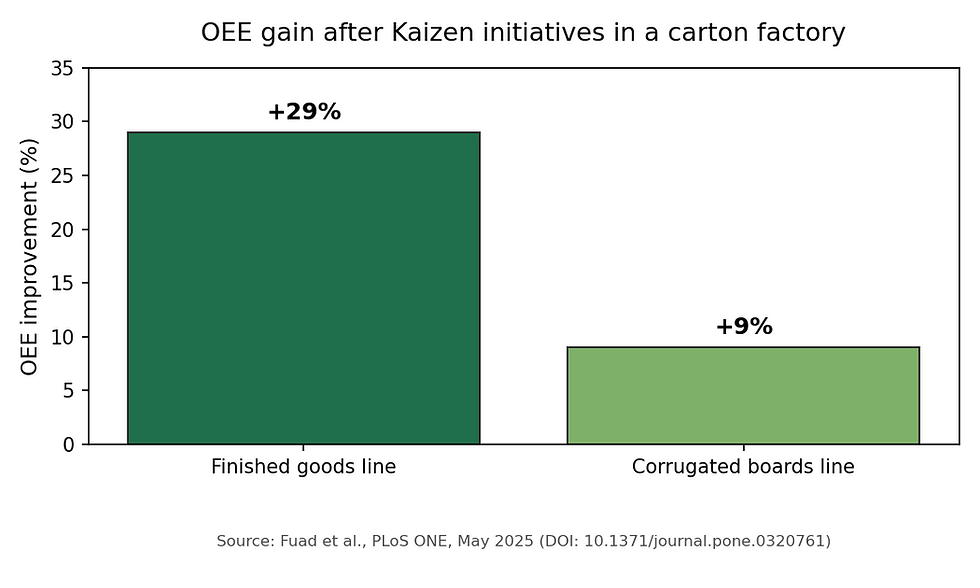
The results can be dramatic. In a 2025 study published in PLoS ONE, researchers ran Kaizen initiatives with Six Sigma methods in a carton factory and measured the gains in overall equipment effectiveness. The finished goods line improved 29 percent. The corrugated boards line improved 9 percent. (Source: Fuad et al., PLoS ONE, May 2025.)
Here is the part most companies skip: what happens after the week ends. A workshop without follow through is just a good week that changes nothing. Pick one number that proves the fix is holding. Check it at 30 days and 90 days. If the number slips, the team meets again and asks why. That is how a five day event turns into a culture.
That is what continuous improvement really is. Not a program. Not a slogan on the wall. One problem, one team, one week, then hold the gains and pick the next problem.
Want to run your first workshop the right way? Contact Rambo Consulting Group. We will help you pick the right problem, bring the right people together, and leave with a fix that sticks.


Comments